Sydney, NSW

Jessamy Huang

Cloud & DevOps Engineer

I build useful tools and cloud solutions, from idea to deployment.

Portrait of Jessamy Huang

About

I have hands-on experience in AWS cloud infrastructure, Terraform, CI/CD, and containerised applications. I enjoy understanding problems, designing practical solutions, and building tools that make everyday work easier. My interests extend beyond cloud engineering to automation, data analytics, and AI applications, with a focus on reliability and continuous improvement.

Hobbies

  • Singing
  • Piano
  • Dance
  • Badminton
  • Mahjong

Experience

  1. Jun 2026 – Sep 2026 Sydney, NSW

    Cloud Solutions Engineer · Contractor

    Jedi Hill TaaS

    Delivered AWS cloud engineering across infrastructure, cost analytics, and automation. Worked with customers to understand technical requirements and develop practical solutions and recommendations.

  2. Sep 2025 – May 2026 Sydney, NSW

    DevOps Engineer · Intern

    Liu & Woodland Law Firm

    Built and supported AWS infrastructure, CI/CD pipelines, and containerised applications. Used Terraform to manage infrastructure and improved deployment workflows through automation, quality checks, and monitoring.

  3. Apr 2021 – Sep 2022 Beijing, China

    Project Engineer · Full-time

    Digital China Cloud Technology Ltd

    Supported AWS and Azure cloud operations for enterprise clients, focusing on billing analysis, cost reporting, access management, and Python scripting to automate repetitive tasks.

  4. May 2019 – Mar 2021 Beijing, China

    Project Coordinator · Full-time

    Futurus

    Coordinated HUD product development across optical, hardware and software teams, supporting Agile planning and milestone tracking.

Skills

Cloud → AWS
  • EC2
  • VPC
  • IAM
  • S3
  • ECS Fargate
  • ECR
  • ALB
  • RDS
  • Lambda
  • SQS
  • Route 53
  • CloudFront
  • Glue
  • Athena
  • QuickSight
DevOps & Infrastructure
  • Terraform
  • Docker
  • CI/CD
  • Bitbucket Pipelines
  • GitHub Actions
  • Azure DevOps
  • SonarQube
  • Linux
  • Git
Observability & Operations
  • CloudWatch
  • Grafana
  • Monitoring
  • Logging
  • Troubleshooting
Programming & Scripting
  • Python
  • Bash
  • SQL
Networking
  • TCP/IP
  • HTTP/HTTPS
  • DNS
  • NAT

Certifications

Projects

Things I've built, from cloud infrastructure and automation to personal applications and creative projects.

Professional Projects

AWS Microservices Deployment Platform

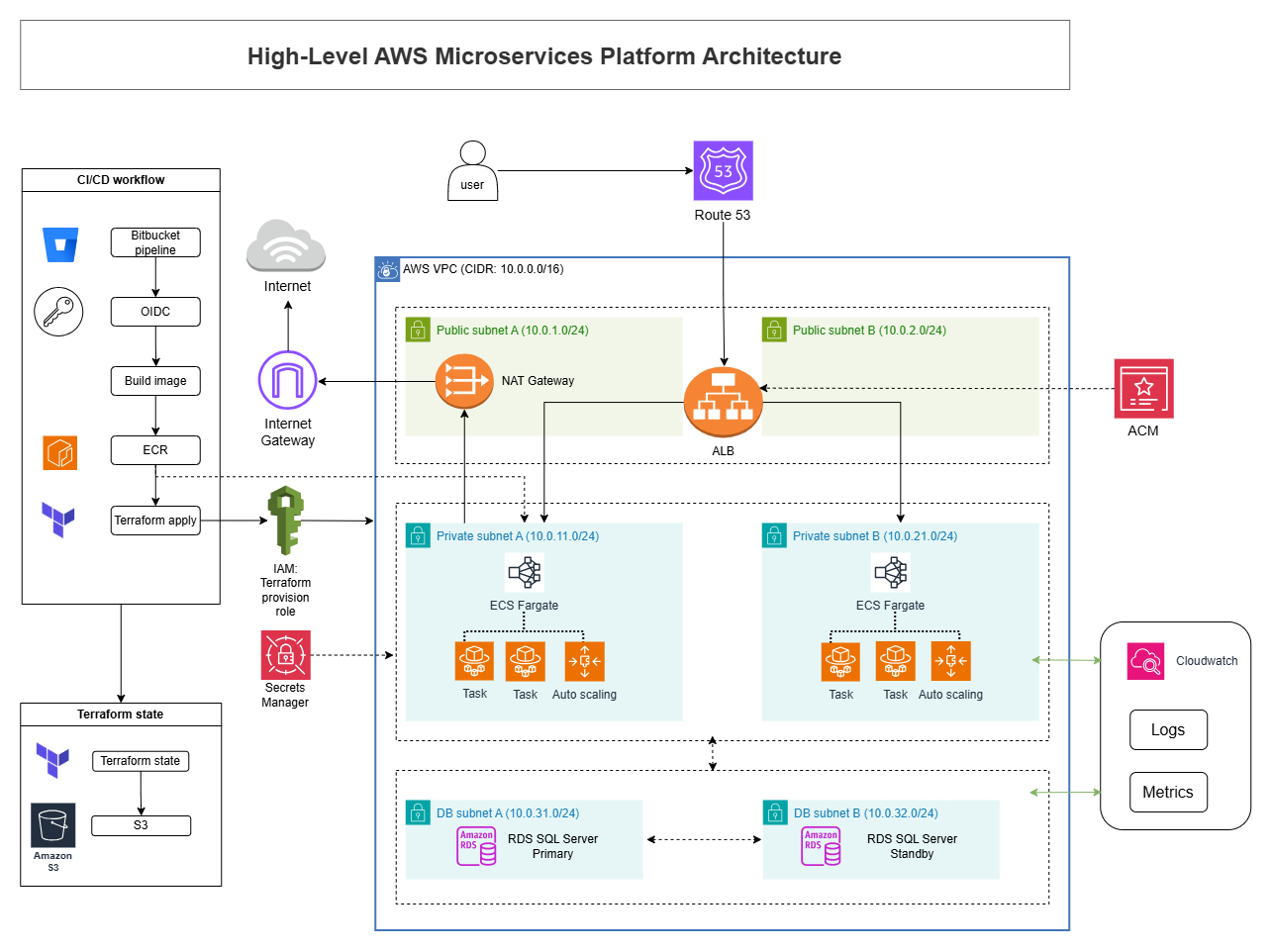
AWS-based microservices platform running on ECS Fargate, with Terraform-managed infrastructure and automated CI/CD workflows focused on reliable, consistent deployments across environments.
  • ECS Fargate
  • RDS
  • Terraform
  • Docker
  • ECR
  • ALB
  • Bitbucket Pipelines
  • SonarQube

AWS Microservices Deployment Platform

Problem
  • Rebuilding every service for each change slowed deployments.
  • Multiple ECS services ran database migrations at startup, creating potential conflicts.
  • Historical SonarQube issues could block new releases.
Architecture
Route 53 → ALB → ECS Fargate → RDS SQL Server
Engineering approach
Provisioned and managed AWS infrastructure with Terraform and automated delivery through Bitbucket Pipelines, including linting, testing, SonarQube quality gates, and deployment health checks.
Key engineering decisions
  • Layered Terraform: Separated shared networking, platform, and service infrastructure to reduce coupling and improve reusability.
  • Smart Builds: Built and deployed only affected services instead of rebuilding everything.
  • Database Migrations: Used a dedicated ECS task to run migrations before application deployment.
  • SonarQube: Focused quality gates on critical issues and new code to prevent legacy issues from unnecessarily blocking releases.
Result
Improved deployment efficiency and reliability, reduced database migration risks, and maintained code quality without unnecessary release blockers.

AWS Cost Analytics & Generative BI

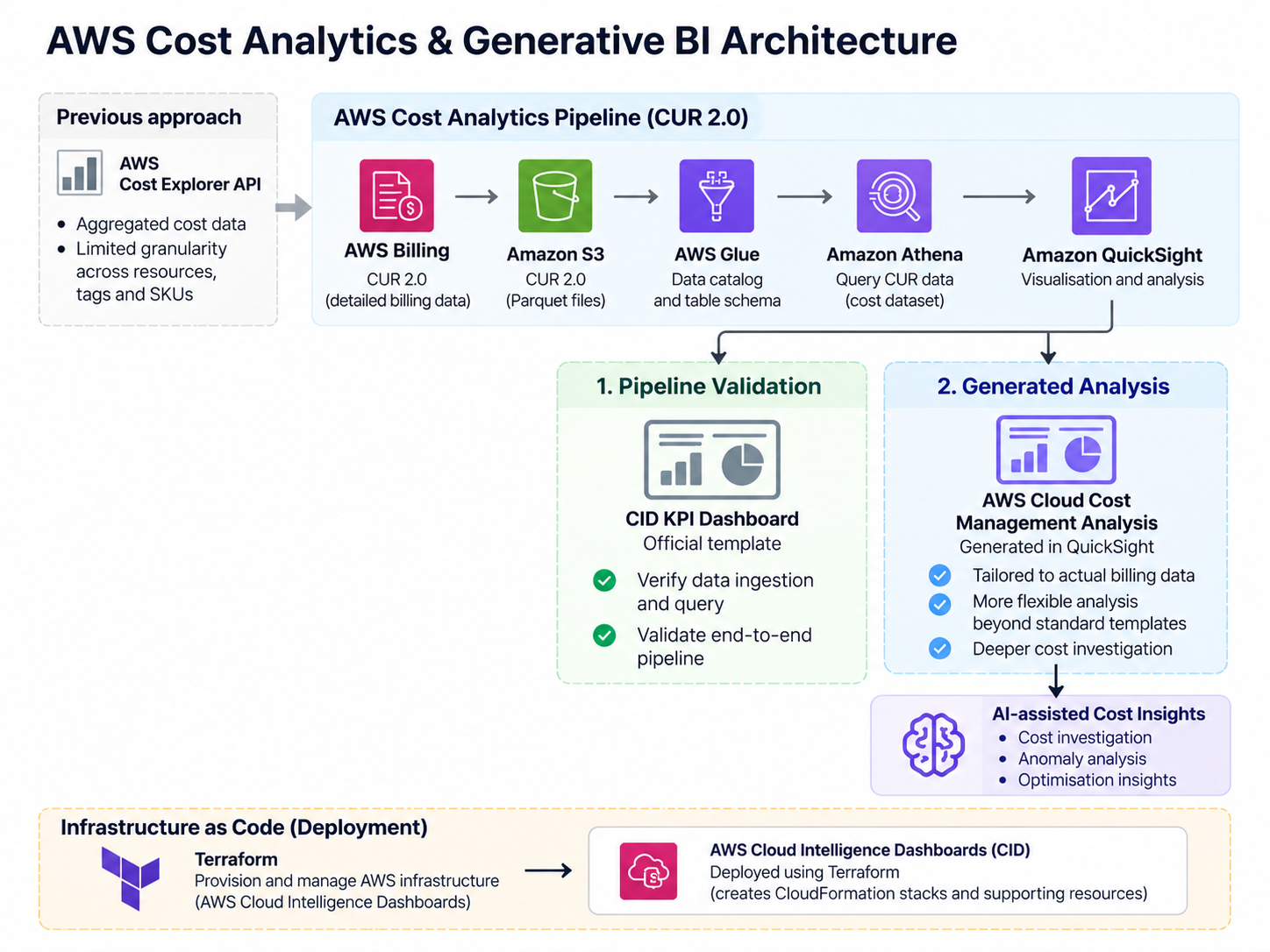
A CUR-based AWS cost analytics pipeline, extended beyond the standard Cloud Intelligence Dashboards with QuickSight-generated analysis and AI-assisted cost insights.
  • CUR 2.0
  • Athena
  • QuickSight
  • Generative BI
  • Terraform
  • FinOps

AWS Cost Analytics & Generative BI

Problem
  • Cost Explorer API reporting lacked the granularity needed for deeper resource-, tag-, and SKU-level analysis.
  • A more flexible approach was needed to analyse detailed AWS billing data and identify cost optimisation opportunities.
Architecture
CUR 2.0 → S3 → Glue → Athena → QuickSight
Engineering approach
  • Deployed AWS CID with Terraform and validated the end-to-end CUR 2.0 analytics pipeline using the official KPI Dashboard.
  • Reused the Athena dataset to generate an AWS Cloud Cost Management analysis tailored to the available billing data.
  • Evaluated QuickSight AI capabilities for cost investigation and optimisation insights.
Key engineering decisions
  • Data granularity: Chose CUR 2.0 over Cost Explorer API for more detailed cost analysis.
  • Architecture reuse: Retained the validated CUR/Athena data layer while adapting the analytics layer.
  • Cost optimisation: Removed unnecessary QuickSight users and AI features to reduce recurring costs.
Result
  • Delivered a reusable AWS cost analytics pipeline with tailored QuickSight analysis and AI-assisted insights.
  • Reduced unnecessary QuickSight and Amazon Q recurring costs through configuration cleanup.

Billing Automation Tool

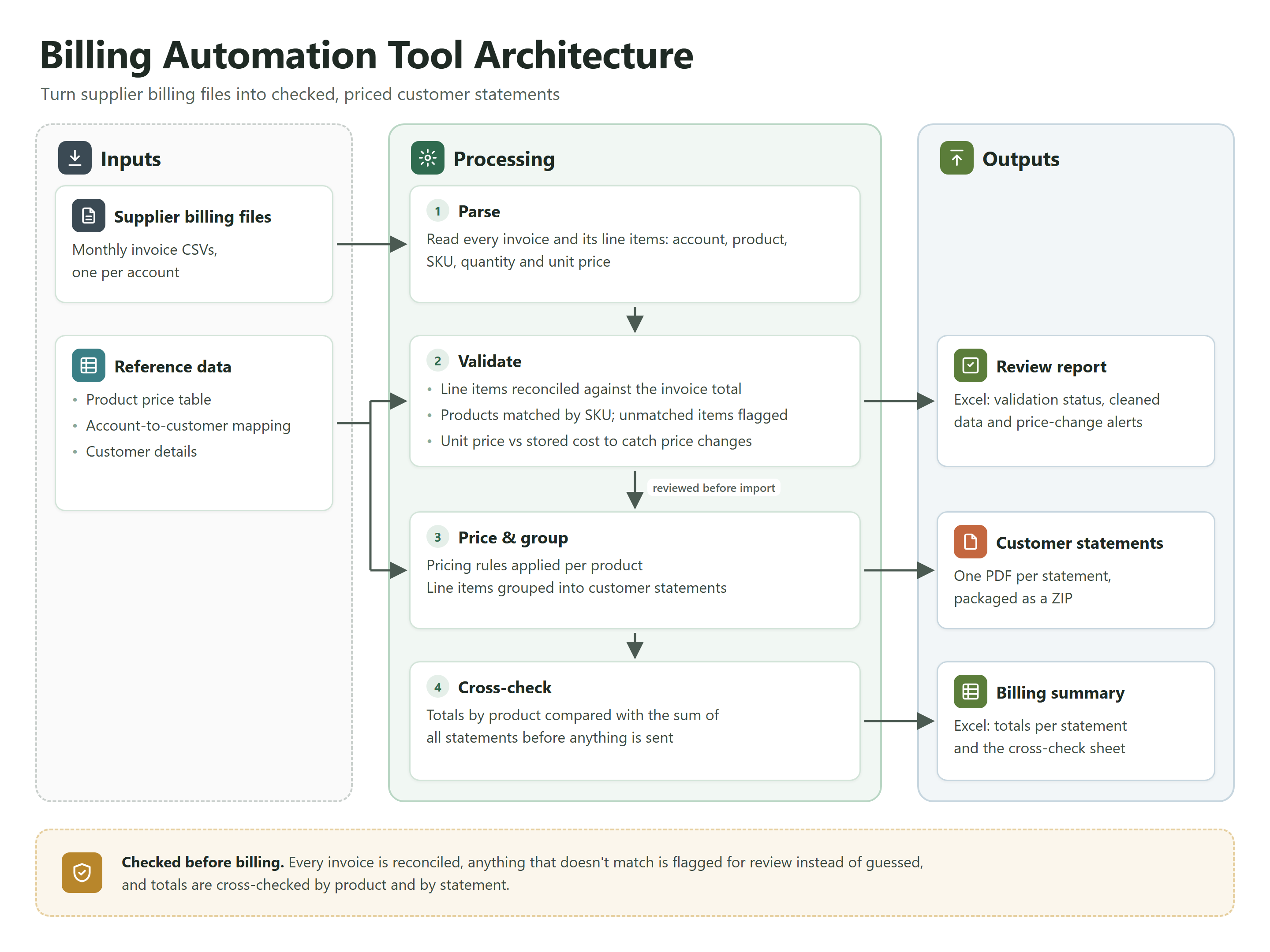
A billing automation and reconciliation solution that processes supplier billing data, applies pricing rules, validates financial accuracy, and generates customer statements.
  • Data Processing
  • Business Automation

Billing Automation Tool

Problem
  • Monthly billing required repetitive manual checks across multiple accounts and statements, making the process time-consuming and error-prone.
  • Manual pricing calculations increased the risk of incorrect prices and totals, with discrepancies difficult to identify before statements were issued.
Architecture
Supplier CSVs → Parse & Validate → Pricing Rules → Statement Grouping → Excel / PDF
Engineering approach
  • Built and refined the tool iteratively using real billing data and existing manual calculations.
  • Used deterministic calculations for all pricing and financial logic.
  • Reconciled supplier invoices and flagged unmatched products, unmapped accounts, and pricing discrepancies.
  • Generated PDF statements and an Excel workbook for review.
Key engineering decisions
  • SKU-based matching: Used exact SKU matching instead of fuzzy product-name matching to prevent silent pricing errors.
  • Independent validation: Cross-checked product totals against generated statements.
  • Exception handling: Flagged unresolved discrepancies for human review rather than making assumptions.
Result
  • Reduced manual billing workload by approximately 70%.
  • Achieved zero difference in reconciled totals between generated statements and supplier billing data during final validation.

Personal Projects

JH TaskOps

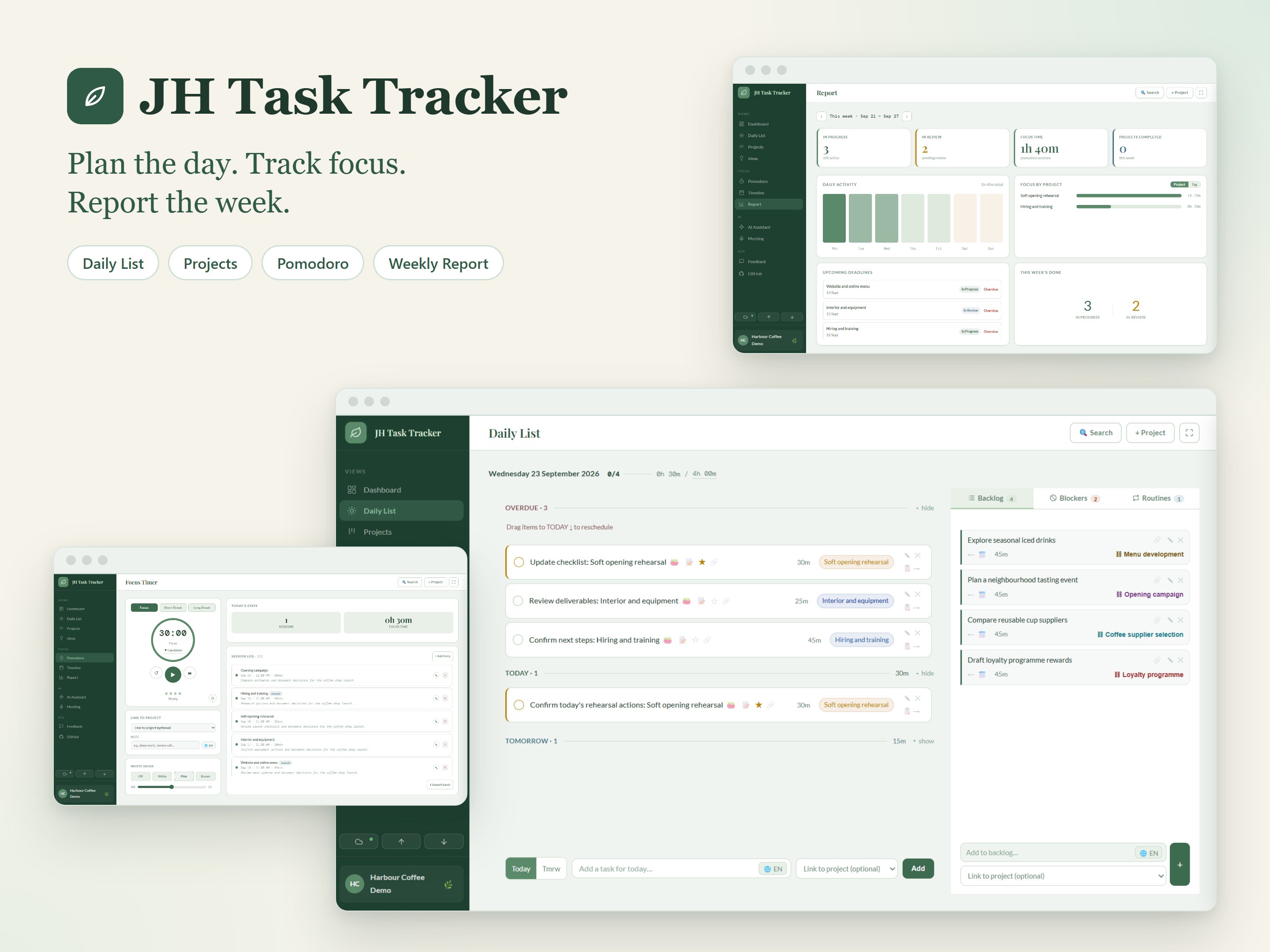
A personal productivity app I built and brought to AWS, with Terraform-managed infrastructure, CI/CD automation and secure deployments.

  • JavaScript
  • S3
  • CloudFront
  • Terraform
  • GitHub Actions
  • OIDC

JH TaskOps — AWS Deployment & CI/CD

Problem
JH TaskOps extends a browser-based productivity app into a publicly accessible AWS application, requiring repeatable infrastructure management and automated deployments.
Architecture
JH TaskOps architecture: GitHub Actions deploys a static app from private S3 through CloudFront; Terraform manages AWS through GitHub OIDC; app data stays in browser LocalStorage with optional Gist sync and Claude API integration
Engineering approach
  • Imported existing AWS resources into Terraform and verified a clean initial plan.
  • Automated Terraform validation and planning on pull requests.
  • Configured merges to main to apply infrastructure changes, deploy frontend updates, and invalidate CloudFront caches.
Key engineering decisions
  • Security: Kept S3 private using CloudFront OAC and HTTPS.
  • Authentication: Used GitHub OIDC instead of long-lived AWS credentials.
  • Access control: Separated Plan and Apply permissions, restricting Apply to main.
Result
Deployed an HTTPS-accessible application with Terraform-managed infrastructure and automated CI/CD.

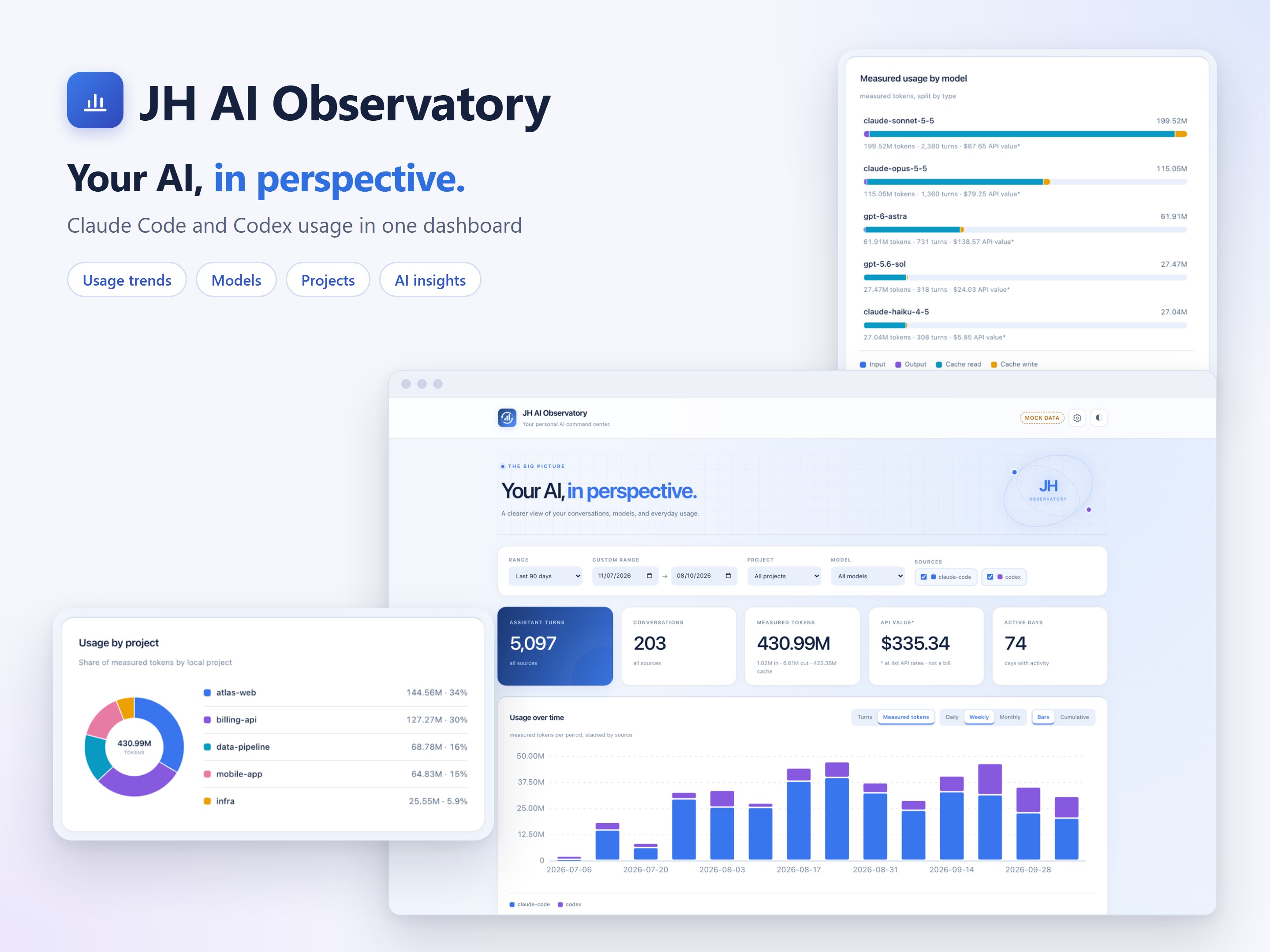
JH AI Observatory

An AI usage analytics dashboard that tracks Claude Code and Codex activity across models, projects, and time, including token consumption, estimated API costs, and AI-powered insights.

  • Node.js
  • Usage Analytics
  • AI Integration

JH AI Observatory

Problem
  • Wanted to understand Claude Code and Codex usage across projects and models.
  • Local usage logs were difficult to analyse, particularly for token consumption, caching, and estimated API costs.
Architecture
JH AI Observatory architecture: Claude Code and Codex logs on the local machine are ingested incrementally into a JSON store, which feeds a CLI and a dashboard served on 127.0.0.1; the dashboard optionally calls the Claude API over HTTPS for AI insights, while raw logs, the store and config never leave the machine
Engineering approach
  • Built a Node.js application to process local usage logs and visualise activity across models, projects, and time.
  • Implemented token tracking, cache analysis, and API cost estimation using configurable pricing.
  • Added automatic refresh, CLI summaries, and AI-powered insights based on usage data.
Key engineering decisions
  • Data accuracy: Distinguished missing token data and unknown model pricing from actual zero values.
  • Cost transparency: Separated estimated API costs from actual billing.
  • Incremental processing: Used file fingerprinting to process only changed logs.
  • Privacy: Kept raw logs and usage data local, with no external database.
Result
Delivered a zero-dependency, locally hosted analytics dashboard with automated updates, cost estimates, and AI-assisted usage insights.

JH Gallery

A personal gallery of music performances, films, and photos, designed like a museum where each year represents a room.

  • S3
  • CloudFront
  • Terraform
  • Python
  • Automation

JH Gallery

Problem
  • Years of performances, films, and photos were scattered across folders, making them difficult to browse and share.
  • Needed a public gallery while keeping original media and personal information private.
Architecture
Local Archive → Python Build → Optimised Media → Private S3 → CloudFront (HTTPS)
Engineering approach
  • Automated deployment to S3, including selective uploads, cache configuration, and CloudFront invalidation.
  • Implemented incremental processing to avoid rebuilding unchanged media.
  • Built a Python pipeline to resize photos, remove EXIF/GPS data, compress videos with FFmpeg, and generate video thumbnails.
Key engineering decisions
  • Privacy: Kept original media and personal metadata outside the public repository.
  • Media handling: Preserved original aspect ratios without cropping.
  • Security: Used private S3 with CloudFront Origin Access Control and security headers.
  • Discoverability: Added noindex to discourage search engine indexing.
Result
Deployed an HTTPS gallery on AWS with Terraform-managed infrastructure and automated media processing and publishing.

Education

  1. Feb 2024 – Jan 2026 Sydney, NSW

    Master of Engineering (Information Technology)

    University of New South Wales

  2. Sep 2015 – Jun 2019 Beijing, China

    Bachelor of Engineering (Electronic and Information Engineering)

    Capital Normal University

Contact

Open to long-term opportunities in Sydney, particularly roles involving hands-on engineering, problem-solving, and end-to-end solution delivery.